Want to start CrossFit but don't know where to begin? Welcome to the club.
At first, it all seems a bit overwhelming: new terms, unfamiliar movements, people who seem to already know everything. The good news is that no one comes to the box as a finished athlete. Everyone has to start somewhere.
We'll show you the 10 best exercises for CrossFit beginners that you should really start with. No show-off moves or Instagram acrobatics, just solid basics that you can build on.
Plus: How the SmartWOD apps can help you bring structure to your training.
CrossFit for beginners: Technique beats speed (and weight)
Before we get to the exercises, here's a point that many people underestimate: CrossFit is intense—but intensity comes after technique.
If your movements are clean:
you will improve faster
you will reduce your risk of injury
you will feel more confident
If they are unclean:
you compensate
you develop bad habits
you stagnate more quickly
Your initial goal is not to be the fastest in the room, but rather to understand and control your movements.
The 10 best exercises for CrossFit beginners
Now let's get to the heart of this article: 10 exercises that are particularly suitable for CrossFit beginners like you.
1. Air Squats
Air squats (basically squats without weights) form the basis for many CrossFit movements. They target the quadriceps and hamstrings (your thigh muscles) as well as the gluteal muscles, while also improving hip and joint mobility.
A proper air squat starts with a firm stance, with your feet slightly wider than shoulder-width apart.
As you lower yourself, your knees should point toward your toes while your hips move back and down—as if you were sitting on an invisible chair.
Keep your back straight and your chest up.
Keep your knees stable and make sure they don't cave in.
Squats without weights are not “beginner stuff,” but the foundation for everything: thrusters, wall balls, cleans.
2. Kettlebell Swings
Kettlebell swings are a great exercise for increasing explosive power and building strength in the lower body and core.
There are two different types: Russian kettlebell swings (you swing the kettlebell up to eye level) and American kettlebell swings (you swing the kettlebell overhead).
Kettlebell swings start in a slightly bent position with the kettlebell on the floor between your feet.
When swinging the kettlebell up to chest height or overhead, it is crucial to use the power from your hips and legs and not from your back.
The arms serve only as an extension, while the swing is mainly generated by hip extension.
Tip: With the SmartWOD Timer, you can set simple intervals, e.g., 30 seconds of swings / 30 seconds of rest.
3. Box Jumps
Box jumps improve plyometric strength and coordination. If you don't feel confident enough to jump onto a high box at first, you can also start with mats or small boxes. Or you can step up instead of jumping.
For box jumps, choose a box at a height that is challenging but achievable.
The focus is on explosive power from the legs to jump onto the box and land with both feet at the same time.
When you land on the box, make sure you are standing straight and your hips are extended (otherwise the jump is considered a “no rep”).
When jumping off, it is important to keep your knees soft to cushion the landing. Alternatively, you can step down.
4. Medicine ball cleans
Medicine ball cleans are a simplified version of the Olympic clean exercise and serve to help you learn the technique for more complex movements. Above all, you learn to quickly “dive” under the ball and position your feet correctly.
The key is to quickly extend your hips, followed by a quick reversal movement.
Squat down and “catch” the ball at shoulder height.
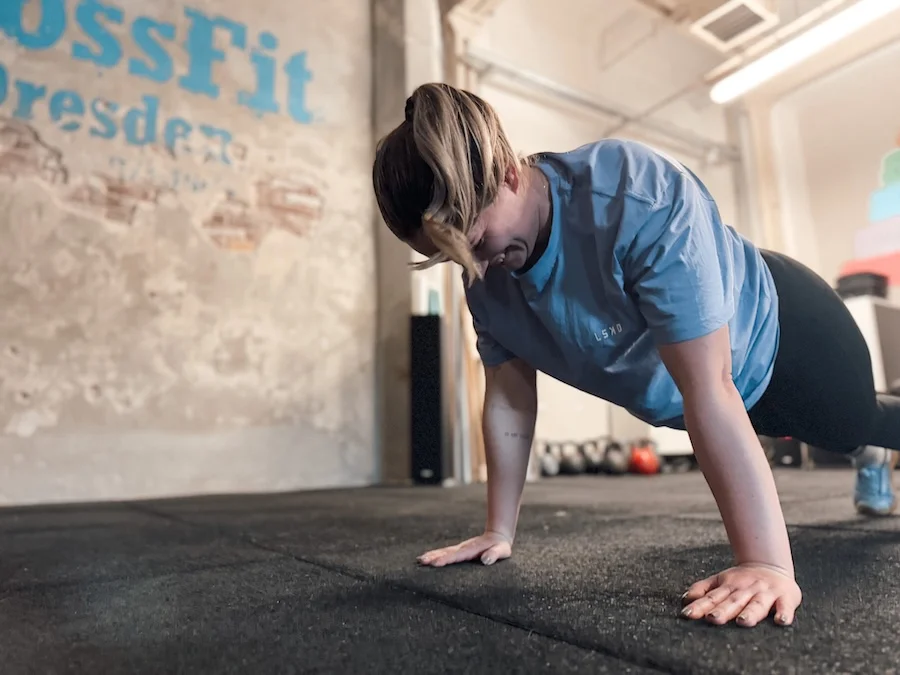
5. Push-ups
Push-ups are a great exercise using your own body weight and strengthen your chest, shoulders, triceps, and core. If they are too difficult for you, you can also do them on your knees.
Make sure your body forms a straight line throughout the entire movement and your elbows stay close to your body.
Lower yourself in a controlled manner until your chest almost touches the floor.
Then push yourself back up explosively to the starting position.
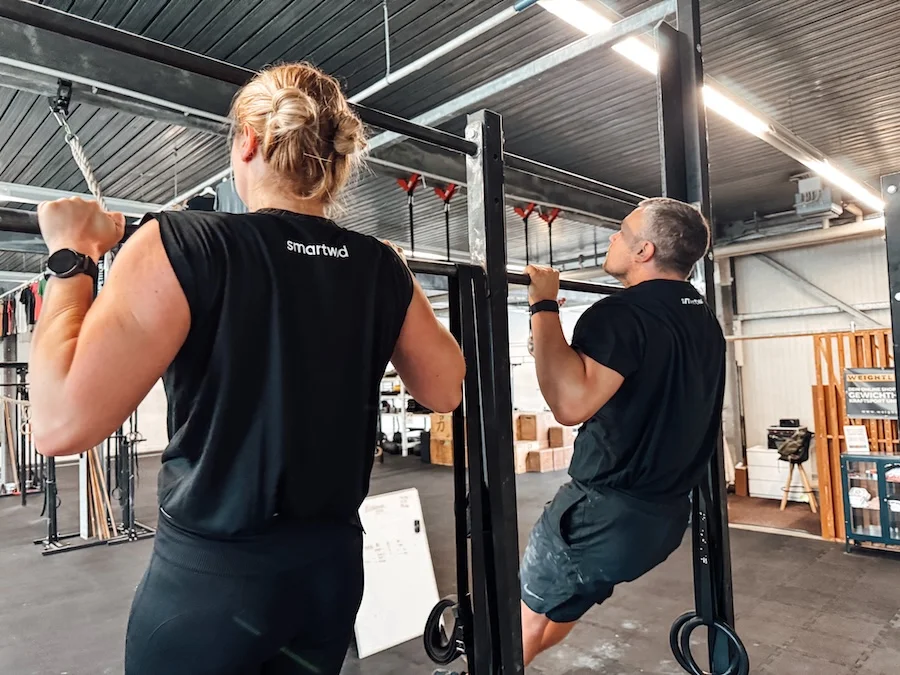
6. Pull-ups
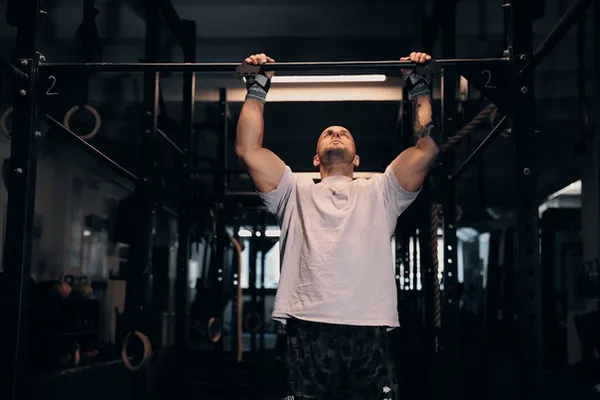
Pull-ups are a fundamental exercise for strengthening the upper body, especially the back and arm muscles. To get started, you can try band-assisted pull-ups or ring rows to build up the necessary strength.
The focus is on controlled movement.
You start in a hanging position with your arms fully extended and pull yourself up.
Continue until your chin is above the bar.
Then lower yourself back down until your arms are fully extended (the so-called “zero position”).
7. Deadlifts with a light barbell
Deadlifts are essential for building strength in the lower back, legs, and glutes. It is important to start with a light barbell and focus on correct form.
Your feet should be hip-width apart.
When lifting and lowering the barbell, the power should come from your legs and glutes, not your back.
Keep the barbell close to your body or shins when lifting, and keep your back straight.
8. Burpees
Burpees are an intense full-body exercise that combines endurance, explosive power, and strength in one. They can be challenging at first, but they are excellent for improving cardiovascular fitness.
Start in a standing position.
Jump into a push-up position and touch your chest to the floor.
Jump back into a squat and then do an explosive jump up.
9. Wall Balls
Wall balls train coordination, strength, and endurance. All you need is a medicine ball (9 kg for men, 6 kg for women—but there are also balls weighing only 4 kg for beginners).
The exercise begins with the medicine ball lying on the floor between your legs.
You pick it up and squat down, holding the medicine ball at chest height.
From the squat position, you stand up straight and throw the ball against a wall or a target (men and women have different heights for this).
You catch the ball and fall back into a squat position.
10. Sit-ups
Sit-ups focus on strengthening your abdominal muscles.
To perform them correctly, start by lying on your back with your knees bent and your feet flat on the floor.
As you come up, your shoulders leave the floor, focusing on tensing your abdominal muscles without putting too much strain on your neck.
How to train these 10 exercises effectively
You don't have to create complicated workouts. With the SmartWOD Workout Generator, even as a beginner, you can have workouts created at random that:
are tailored to the equipment you have available
take your level into account
are automatically structured
You simply select what you have available—the app does the rest. This is invaluable, especially at the beginning, because you don't have to think about what to train each time.
Your introduction to CrossFit starts now!
You don't need a perfect plan or a spectacular start. You just need to be ready to get started—and stick with it.
The exercises in this article are the foundation on which everything else in CrossFit is built. If you learn them properly, train patiently, and give yourself time, progress will come almost automatically.
Make it easy for yourself to stay consistent. Use clear structures, plan your training, and track your sessions. Whether you use a simple notebook or tools such as the SmartWOD Timer and the Workout Generator, the main thing is to create a system that supports you.