At first glance, ring rows seem unspectacular. You hang from the rings, pull yourself up, and that's it. That's exactly why they are often underestimated.
Ring rows are among the most effective bodyweight exercises you can do (not only) for your back.
Because once you perform ring rows correctly, you will quickly notice that this exercise mercilessly reveals how good your body tension is, how cleanly you can pull, and whether your back is really working—or whether other muscles have been compensating for it up to now.
What exactly are ring rows?

Ring rows are a pulling exercise using your own body weight, performed on gymnastic rings. You pull your upper body horizontally toward the rings while your feet remain on the floor.
The key feature of ring rows is their adaptability. You can determine how challenging the exercise is by adjusting your body position:
If you stand relatively upright, it becomes easier.
If you bring your body closer to the horizontal, the load increases significantly.
The freely movable rings require you to actively stabilize each repetition. There is no fixed trajectory, no “trick” that does the work for you.
That's exactly what makes ring rows so valuable: they force you to use clean technique, keep your body tense, and consciously control your movements.
Ring rows vs. pull-ups – what's the difference?
Ring rows and pull-ups are often compared, but they serve different purposes in training.
The most important difference lies in the load:
With ring rows, part of your body weight remains on the ground. This makes the exercise more controllable and easier to scale.
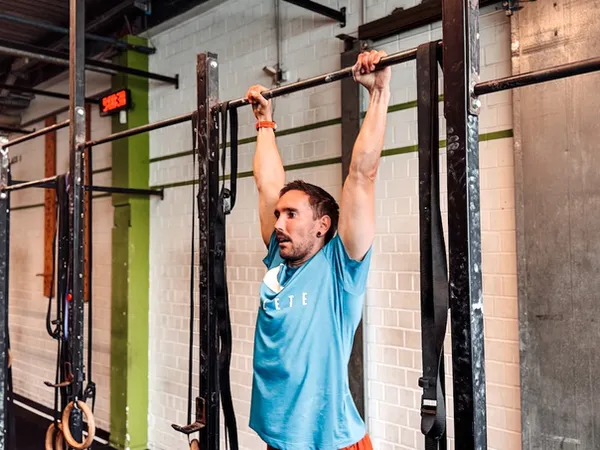
Pull-ups, on the other hand, are a vertical pulling movement in which your entire body weight hangs freely. The strength requirements are correspondingly higher.
The training focus also differs:
Ring rows are ideal for learning basic pulling mechanics: actively guiding the shoulder blades, pulling the elbows cleanly, maintaining body tension. You can focus on technique and control without immediately reaching your strength limit.
Pull-ups require precisely this foundation. If it is lacking, the execution often suffers. Momentum, unclean shoulder movements, or cheating are then not a question of motivation, but of a lack of foundation.
In short: Ring rows build strength, technique, and control. Pull-ups challenge these skills under maximum load. Both exercises have their place—but they don't serve the same purpose.
Which muscles do I train with ring rows?
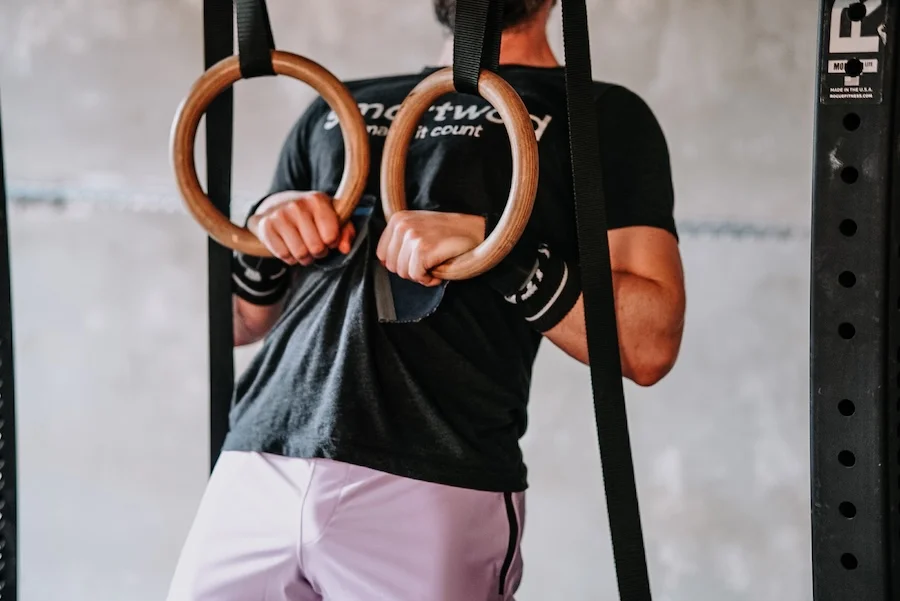
Ring rows are often considered a classic back exercise—and rightly so. But if you perform them correctly, they engage significantly more muscles than many people think. That's exactly what makes this exercise so effective.
The main work: your back
Most of the work is done in the upper back. This mainly includes:
Latissimus – provides the pulling motion
Rhomboids – pull the shoulder blades together
Middle trapezius – stabilizes the shoulder girdle
These muscles are responsible for pulling yourself toward the rings in a controlled manner, rather than simply pulling with your arms.
Supportive: Arms and shoulders
Your arms and shoulders also work, but not as the main actors.
Biceps: supports flexion in the elbow
Rear shoulder: helps with the pulling movement and stabilization
If you do ring rows correctly, you will quickly notice that your arms help, but they do not take the lead. If the exercise feels like pure arm training, there is usually something wrong with your technique.
Often underestimated: core strength and body tension
Much of the work happens where you might not immediately expect it: in the core.
Abdominal muscles keep the body stable
Glutes prevent the hips from sagging
Lower back stabilizes the body line
Without this tension, the exercise will not work properly. Ring rows are therefore not an isolated back exercise, but a pulling movement for the whole body.
Why this is important
It is precisely this combination that makes ring rows so valuable. You are not only training individual muscles, but also the interaction between your back, arms, and core. This not only improves your strength, but also your body control—and directly transfers to other pulling movements such as pull-ups or deadlifts.
How do I perform ring rows correctly?
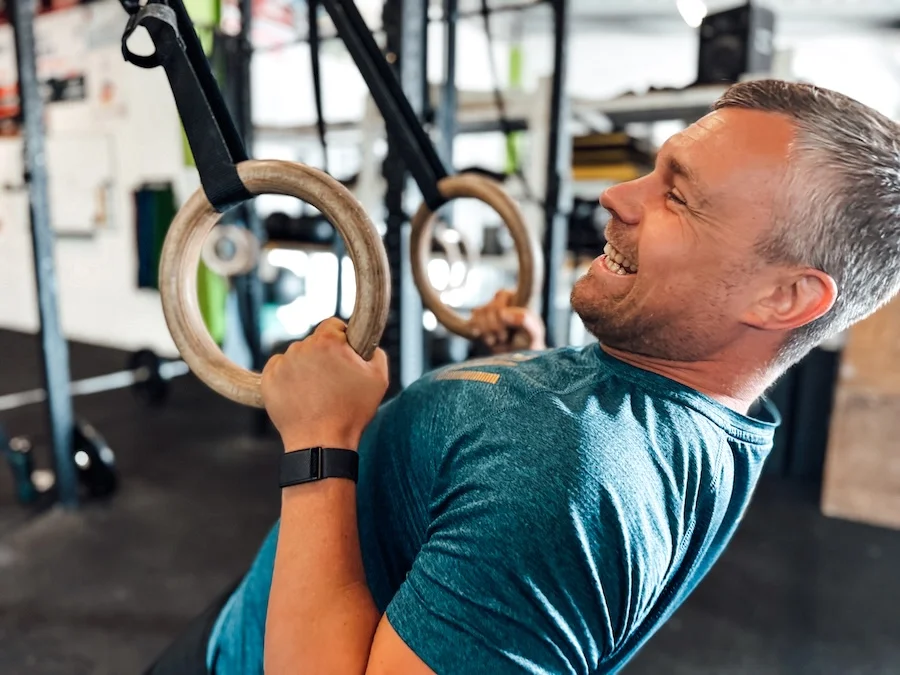
With ring rows, the execution determines whether you are really training your back. The exercise thrives on tension, control, and a clean pulling mechanism. It is better to take your time than to simply reel off repetitions.
1. The correct setup
Set the rings at about chest height. Grasp them neutrally, with your palms facing each other. Your feet are flat on the floor and your body is leaning slightly backward.
Important:
The more upright you stand, the easier the exercise will be.
The more horizontal your body is, the more challenging it will be.
It is better to start a little easier and then work your way up.
2. Build up body tension
Before you even pull, tense your body:
Buttocks active
Abdomen tense
Chest stable
Your body should form a straight line—from your head to your heels. No sagging in the hips, no hollow back. Maintain this tension throughout the entire repetition.
3. The pulling motion
The motion does not start in the arms, but in the shoulders.
First, remember to:
Pull your shoulder blades back and slightly down.
Only then should you bend your elbows. Keep them close to your body and move them backward in a controlled manner.
Pull yourself up until the rings are approximately at chest or rib height.
4. The final position
The shoulder blades are active, the body remains tense. Do not push your chest up, do not tense your neck.
If you cannot hold the position for a short time, the exercise is currently too difficult for you.
5. Controlled lowering
Lower yourself slowly. This is where a lot of the training stimulus occurs. If you lose tension while lowering, each repetition will be sloppy.
A good guideline:
Pull up in a controlled manner
Lower yourself consciously and calmly
How heavy should ring rows be? (Scaling & progression)
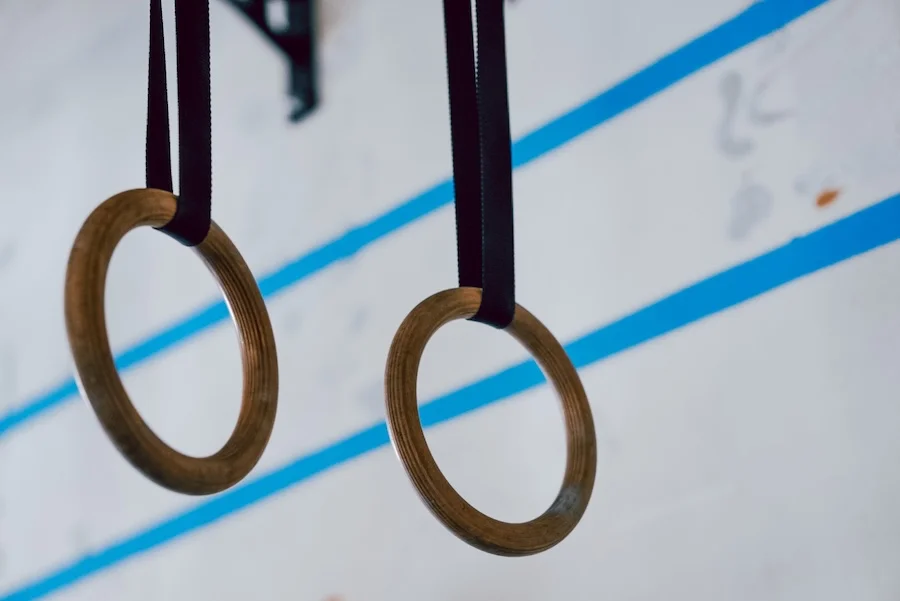
In short: so heavy that you can pull cleanly—but don't have to compensate. Ring rows are effective when your technique and tension remain stable. As soon as you start cheating, the load is too high.
How to scale ring rows
The resistance comes not from weight, but from your body position:
Make it easier
Stand more upright
Set the rings higher
Reduce your speed slightly to maintain control
Make it harder
Move your feet further forward (body closer to horizontal)
Set the rings lower
Take a short pause at the top (hold for 1–2 seconds)
Lower slowly (3–4 seconds eccentric)
Even small changes in angle make a big difference.
How to tell if it's right for you
A good level of difficulty is evident in the following ways:
The last 2–3 repetitions are challenging
Your body tension remains stable until the last rep
You don't feel like you're “just getting up somehow,” but rather consciously pulling
Progression without stress
You don't have to complicate things with “periodization” for ring rows. Keep it simple:
If your technique remains stable → make the angle slightly steeper
If everything feels too easy → slow down your pace
If you lose tension → take a step back
Progression in ring rows does not mean going as hard as possible every week, but rather pulling cleaner, more controlled, and stronger over time.
Why ring rows should be part of your training plan
Ring rows are inconspicuous but extremely effective. They strengthen your back, improve your body tension, and make you cleaner in all pulling movements.
Whether you want to get stronger, move better, or simply train more solidly, this exercise pays off.