Do you look forward to rope climbs in your workout—or do you hope every time that something else is written on the whiteboard?
Most athletes have a love-hate relationship with rope climbs. They look spectacular, but often feel much more exhausting than they appear—especially when you try to pull yourself up the rope using only your arms.
The good news: That’s exactly how you shouldn’t be doing rope climbs anyway.
Efficient rope climbing has surprisingly little to do with raw strength. It’s much more important that you master the right technique and learn to use your entire body.
What are rope climbs?
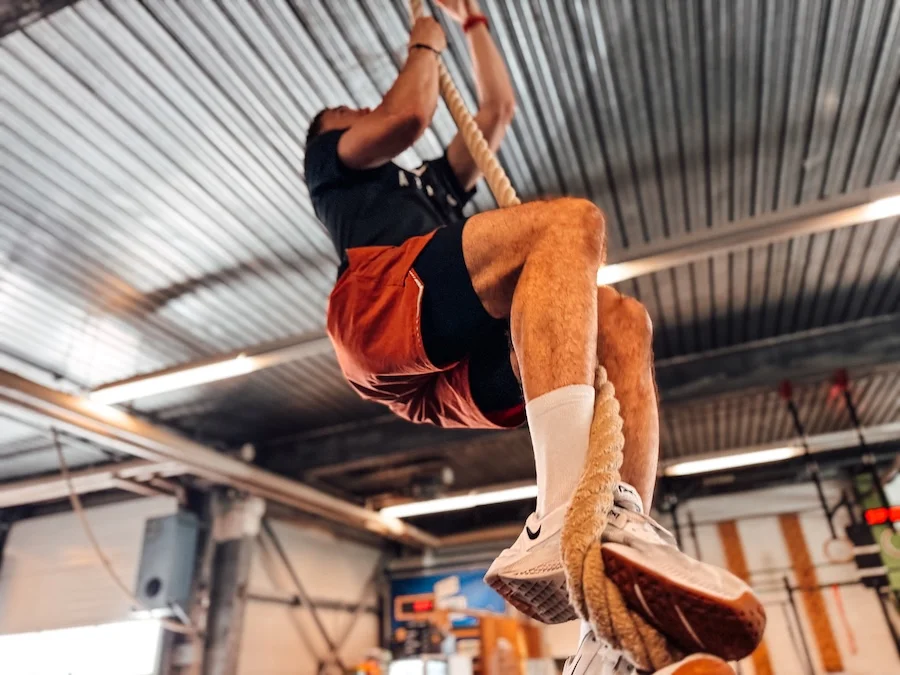
At first glance, a rope climb seems pretty simple: You grab the rope, pull yourself up, and climb to the marker or the gym ceiling. But there’s actually a lot more to it than that.
A rope climb is not a traditional strength exercise like a bicep curl, nor is it a pure gymnastics movement like a handstand walk. Instead, rope climbing combines various skills.
You need pulling power, body tension, coordination, grip strength, and proper footwork. Only when these elements work together does a grueling struggle against the rope become a fluid movement.
That’s exactly why you’ll regularly encounter rope climbs in functional fitness and CrossFit. They test not only your strength, but above all your ability to work efficiently—especially when your heart rate is already high and the rope is waiting for you in the middle of your workout.
Rope Climbs in Functional Fitness
Depending on the workout, rope climbs can be used in a variety of ways.
Sometimes the goal is to complete a specific number of repetitions as quickly as possible.
In other workouts, rope climbing is sandwiched between heavy deadlifts, burpees, or runs, providing an extra challenge even though your forearms and back are already fatigued.
That's exactly what makes rope climbs so special: they never happen in isolation. They're almost always part of a larger whole and require you to perform cleanly even when you're tired.
Which muscles do rope climbs work?
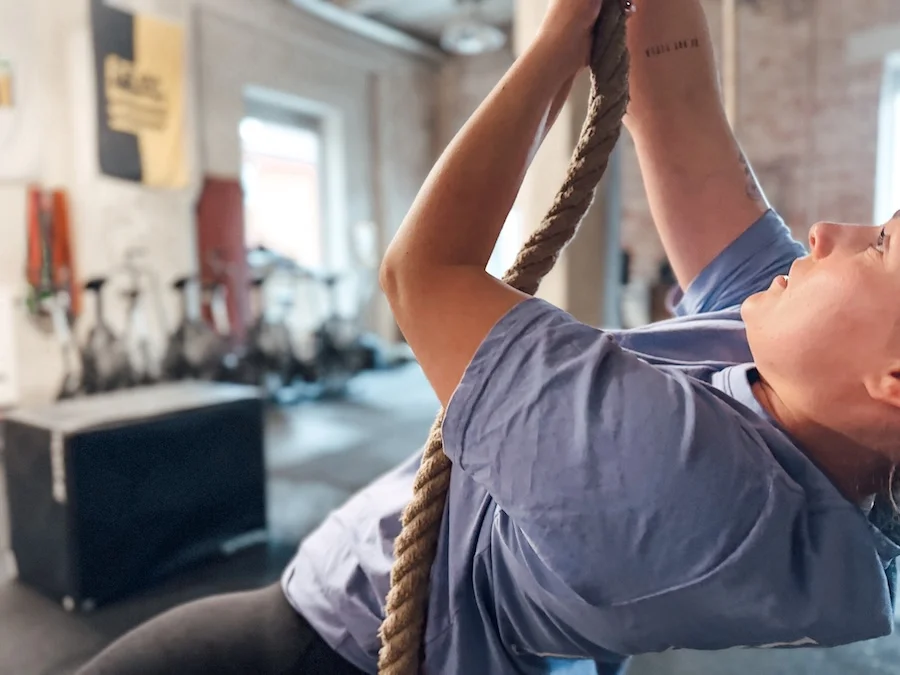
Rope climbs are much more than just an arm exercise. To climb efficiently, your entire body has to work together.
The main muscle groups are:
Latissimus: The latissimus dorsi is the primary driver of the movement. It generates most of the pulling force and pulls your body upward.
Biceps and forearms: They support the pulling motion and ensure that you can grip and control the rope securely.
Shoulders and upper back: These muscle groups stabilize your shoulder joints and help you execute the pulling motion smoothly.
Core: An engaged core keeps your body stable, prevents unnecessary swaying, and makes it easier to lift your legs for the next foot hook.
Legs: Often underestimated, but crucial for an efficient rope climb. With the right foot technique, you can do a large part of the work with your legs and conserve valuable upper-body strength.
In short: The better your back, core, and legs work together, the less you'll have to rely solely on your arms to pull yourself up the rope.
Rope Climbing Technique: How to Climb a Rope Properly
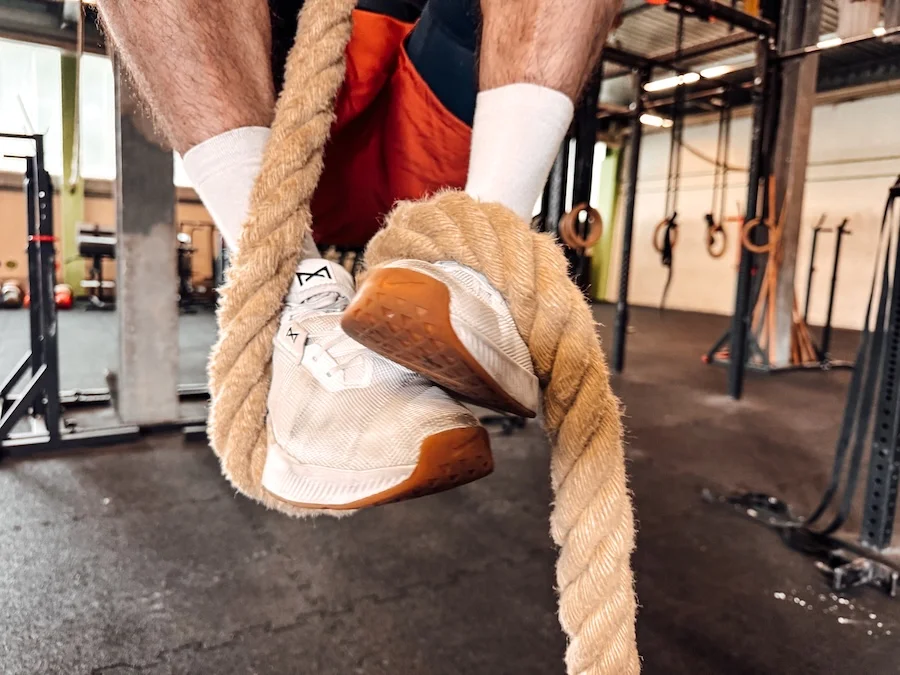
When you're learning rope climbs for the first time, you'll probably automatically focus on your arms. Instead, try to think of the movement as a series of small steps.
The Starting Point
Grab the rope as high up as possible with both hands and immediately create tension. Keep your shoulders engaged, your core tight, and your feet on the ground for now.
Don’t pull yourself up as far as possible right away. Instead, start by pulling hard while simultaneously bringing your knees toward your chest. This is exactly what creates the space you need to clamp the rope between your feet.
The J-Hook
The J-hook is the technique most athletes use to learn rope climbs. To do this, you guide the rope along the inside of one leg and then tuck it under your foot. The other foot presses down on the rope from above to hold it in place.
Once the rope is securely clamped in place, you can push yourself up using your legs. This saves a tremendous amount of energy because your arms don't have to support your entire body weight while you're doing it.
The S-Hook
With the S-hook, the rope runs in an S-shaped line between both legs and feet. This technique is slightly faster and is preferred by many experienced athletes.
At the same time, however, it requires more practice because the foot loop must be secured properly. If it isn't, the rope can slip more easily.
The Way Down
There's a lot of talk about climbing up. About descending, on the other hand, surprisingly little. Yet this is exactly where many sloppy repetitions occur.
Don't just let yourself slide down the rope. That puts unnecessary strain on your hands and skin and causes you to lose control of your descent. Instead, release your foot loop in a controlled manner, guide your hands down the rope one after the other, and descend as smoothly as possible.
This helps you conserve energy—especially during workouts that include multiple rope climbs—while also giving your hands a break for the next reps.
Rope Climb Variations in Functional Fitness
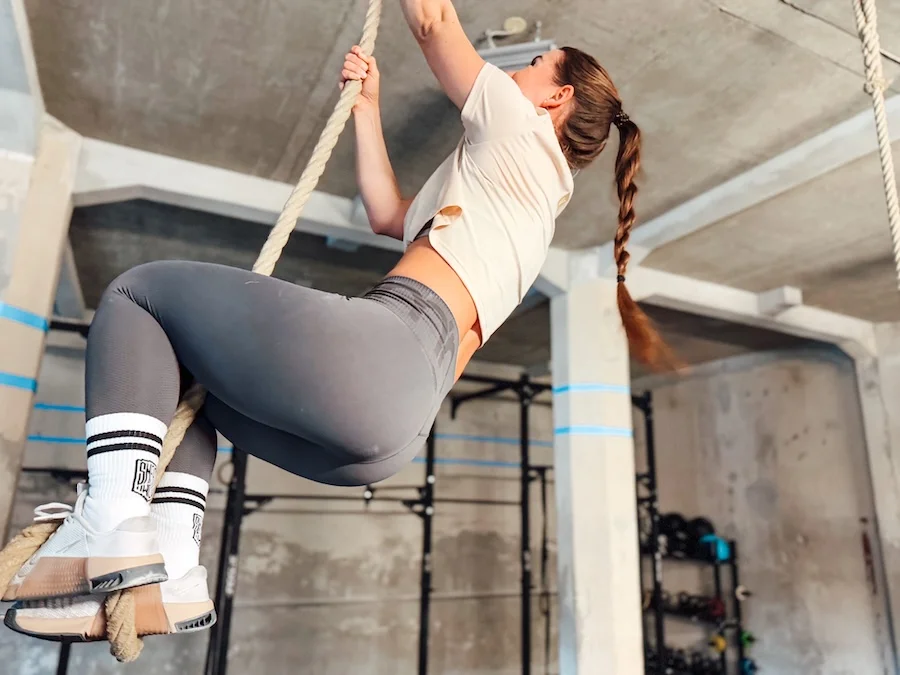
Not all rope climbs are the same. Depending on the workout, competition, or training goal, you'll encounter different variations—some focus on technique, others on maximum strength or speed.
Rope Climb with Foot Technique: When people talk about rope climbs in functional fitness or CrossFit, they’re usually referring to the variation that uses foot technique. In this variation, you use the J-hook or S-hook to secure the rope between your feet. This allows you not only to pull yourself up with your arms but also to push yourself up using your legs.
Legless Rope Climbs: Here, you completely avoid using your legs. However, that doesn’t mean they’re just hanging in the air. You still need to engage your core to keep your body stable. The key difference is that your legs can no longer actively push you upward. This significantly increases the strain on your back, arms, and grip strength.
L-Sit Rope Climbs: Here, your legs remain extended in front of your body throughout the entire movement. This not only eliminates support from your feet—it also requires your core to maintain maximum tension at all times.
Scaling Rope Climbs: These Alternatives Will Help You Improve
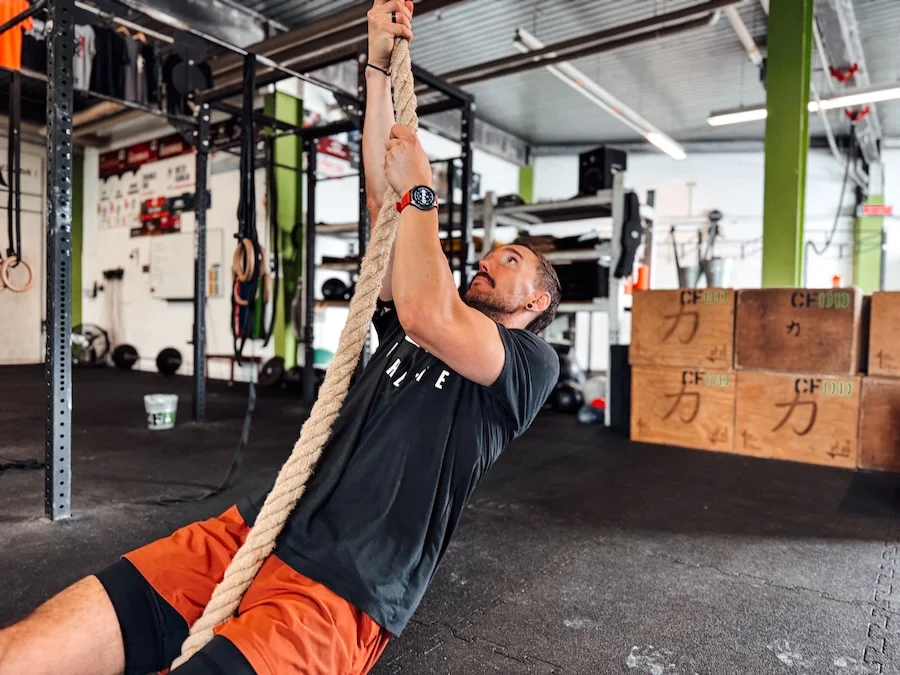
Not every gym has a climbing rope, and not every athlete has already mastered rope climbs. That’s completely normal. The key isn’t to force the movement in any way, but to specifically develop the skills behind it.
The following can help:
Rope Pulls: One of the best warm-up exercises is rope pulls. To do this, sit on the floor and pull the rope toward you using only your arms. This helps you build grip strength, pulling power, and the proper movement pattern without having to climb at the same time.
Towel Pull-ups: If a rope isn’t available, towel pull-ups are an excellent alternative. To do this, hang two towels over a pull-up bar and pull yourself up using them. Because the grip is significantly thicker, you’ll need to exert much more grip strength—a skill that will also benefit you later during the rope climb.
Pull-ups and Ring Rows: Classic pull-ups and ring rows also help you build the necessary pulling strength. While they don’t completely replace rope climbs, they strengthen exactly the muscle groups you’ll need later on the rope.
Rope Climbs: Technique Beats Strength
Rope climbs are among the most impressive exercises in functional fitness—and for good reason. They look spectacular, are quite challenging, and regularly push many athletes out of their comfort zone.
That’s exactly why it’s worth investing time in mastering the technique. Of course, you need strength to complete a rope climb safely. But even more important is how you use that strength.
Once you learn to engage your legs effectively, build core tension, and develop a clean rhythm, you’ll quickly realize that rope climbing is much less exhausting than you thought.